|
David's "Big Beede" full sized dulcimers... New Models info HERE This page will have images of the new models soon! |
NEW Aaron O'Rourke won 2010 National Dulcimer Champion at Winfield Kansas! NEW Erin Rogers plays her first gig with her new chromatic dulci. |
||
 |
The basics are: Hourglass, upper bout 5.5", lower bout 7.5", body 2 " deep, overall depth 3", length 35", 25" string length. |
||
|
|
This hourglass model evolved in collaboration with my friend Aaron O'Rourke , who approached me with a few interesting ideas arising from his playing style. There are links to some videos of Aaron playing a couple of the prototypes below. |
||
|
|
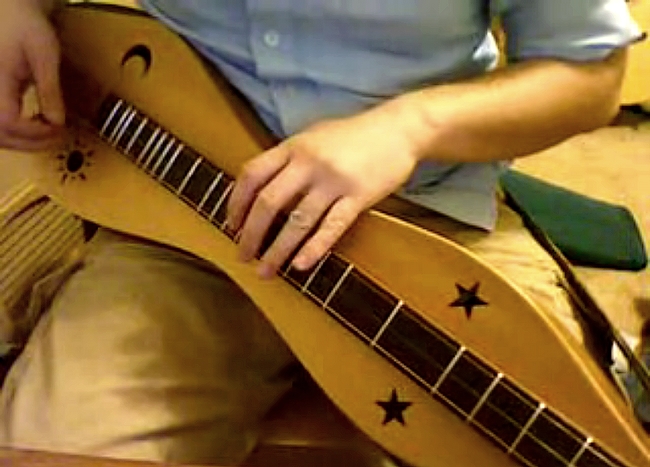
One was a bevel on the lower bout where his forearm rests while playing. Something harder to show in a photo is the radiused fingerboard. This has become standard for many instruments, like steel string guitars, and mandolins but until recently hasn't been done on mountain dulcimers. It greatly facilitates baring and bending strings. |
||
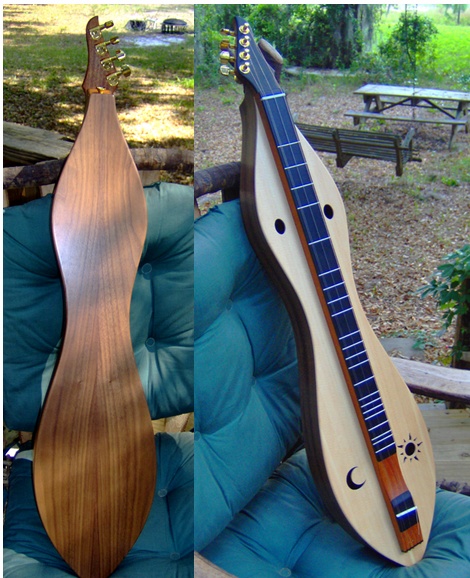 |
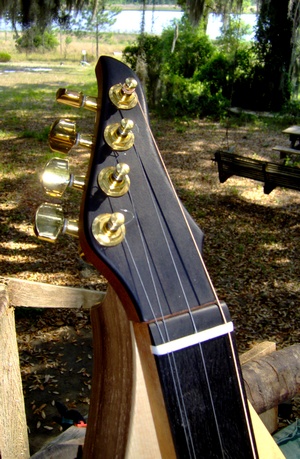
Like this one they are also available without the bevel or radius fret board. This one has a walnut body Sitka spruce top ebony fingerboard and peg head overlay 1 1/2 & 6 1/2 & 8 1/2 frets |
||
|
|
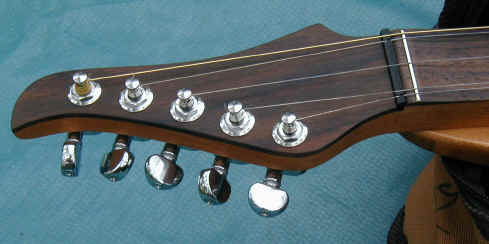
Gold Ping tuners Bone nut notched for either this very common "three string" arrangement with doubled melody string, or four equidistant strings. |
||
|
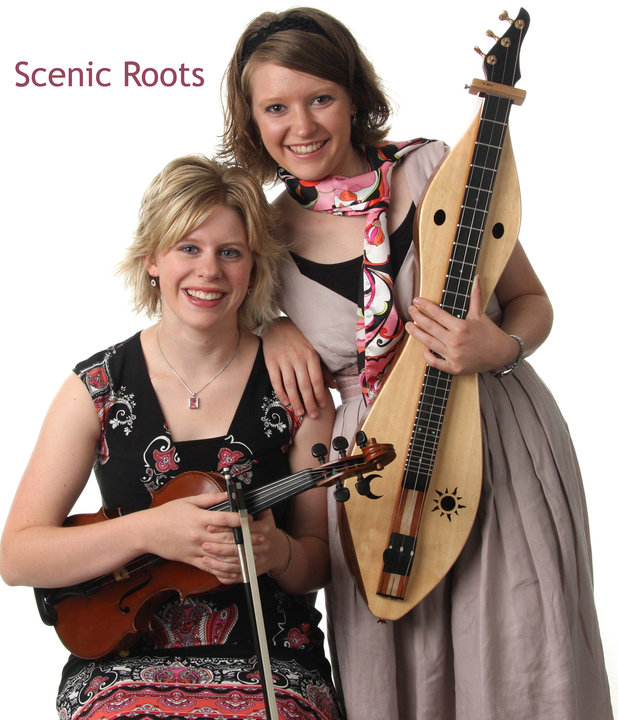
Amber & Erin Rogers
"Scenic Roots" new promo photo |
Click photo for larger image. |
||
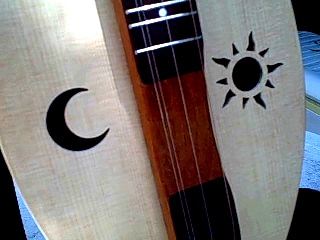 |
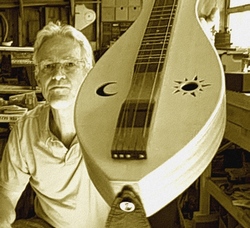
"Celestial" Sun & Moon sound hole design |
||
|
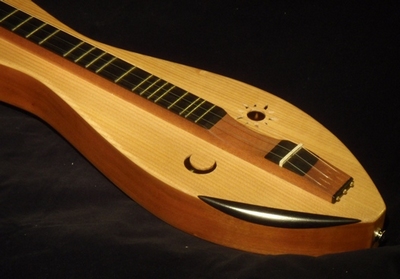
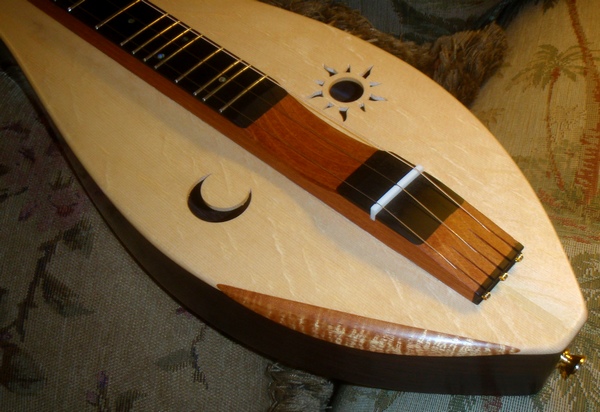
Here's one I built for Aaron O'Rourke with "bear claw" sitka spruce and a koa bevel. All dulcimers use a tailpiece of my own creation. It's a variation on a “de-coupled” tailpiece, which results in a fuller bass response. The strings terminate at the end of the fingerboard which is not only inset from the end block, but is also undercut. [Howie Mitchel was the first builder I'm aware of using a version of such an approach, in the '60s.] |
 |
||
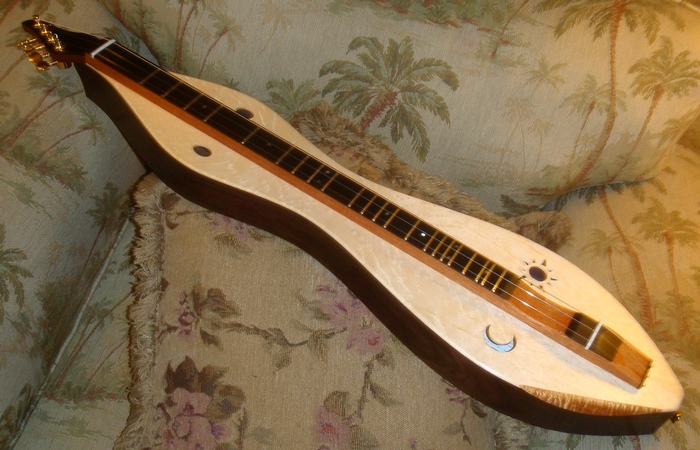 |
Here's the full front of the same instrument. | ||
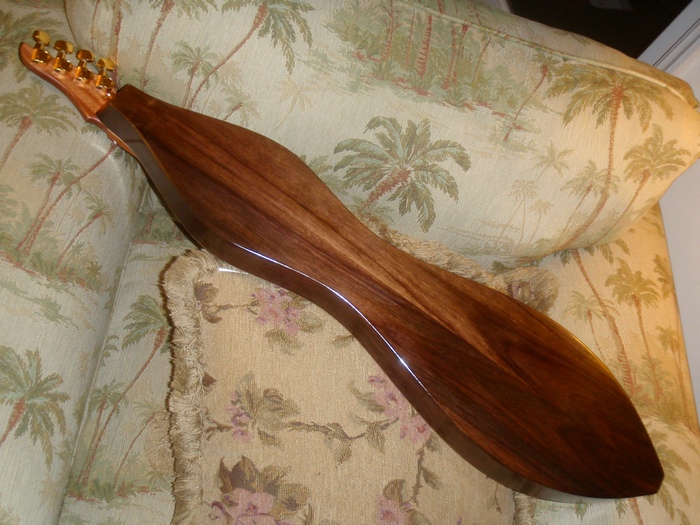 |
Here's the back of Indian rosewood. | ||
|
|
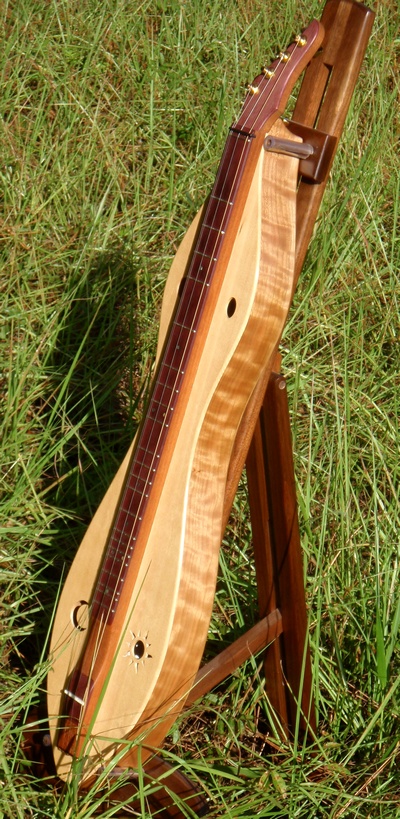
This is some "quilted cherry" that shows up rarely. If I can get it there is a modest additional charge. Acoustically it behaves like un-figured cherry but is more challenging to bend.
I used this dulcimer on this cover of Leonard Cohen's The dulcimer's tuned to C#. |
||
|
|
This shows the first prototype of this model. Mahogany, spruce and wenge fingerboard and bevel. Stars or ovals are available in upper bout. You can hear this one in Aaron's "Hi Mom" video clip linked below. |
||
|
I hope this hand full of pictures and videos helps give you an idea of these instruments. I take great pride in the precision of their intonation and the quality of their sound. I spend more time than is reasonable or sensible on the, fingerboard, frets, intonation and action... but then, I am also a player and I like to feel my fingers go "aaaaaaahhhh..." when they touch the strings. If you do too, contact me. |
David Beede Chomatic Mountain Dulcimer Demo by Stephen Seifert from Stephen Seifert on Vimeo. |
||
| Aaron O'Rourke, 2010 National Dulcimer Champion - playing Bill Cheetham on his mahogany Beede dulcimer. Thank you Dan Landrum for catching the video. | |||
|
Here's something you don't get to hear often! Aaron and Dan Landrum play a dulcimer / hammered dulcimer duet of Arkansas Traveler. [Aaron starts on guitar but the dulcimer comes in later.] I particularly like how lovely the melody sounds slowed down. |
|||
| New Waiting List system info here | Contact info is on the waiting list PDF too. | ||
|
A little tour of a walnut, spruce and ebony dulcimer. |
Beede dulcimer details from David Beede on Vimeo. A few words about the sound I try to achieve. |
||
|
Aaron plays this original composition on prototype #1 Mahogany and Sitka spruce, wenge. |
Aaron plays prototype #2 Cherry & Sitka spruce with his Trio. Check out Aaron's web site. |
||
|
Demo of a chromatic dulcimer I built for Erin Rogers. |
|||
|
|
|||
Demo of how my "decoupled tail piece" effects tone.
|
Back to home page |